
By: Lt Col Michael A. Bradford

The cadet cadre waits to greet basic cadets from the Class of 2029 by the footprints at the base of the Core Values Ramp. (U.S. Air Force photo by Jonathan Suni)
“Virtue of character (ēthos) is a result of habituation (ethos), for which reason it has acquired its name through a small variation on ‘ethos.’ From this, it is clear that none of the virtues of character arises in us by nature.”[1]
Aristotle
Historically, competence has been the foremost determinant of an individual’s preparedness for promotion. The Air Force is oriented to speak about character, but evaluate competence. Today’s hiring and organizational thinking practices may stem largely from productivity-based measurements of the early 20th century. Today, as seen through the examples of Colin Powell and the interviews of Air Force leaders, modern leaders must possess both competence and character to lead effectively. This article presents the Competence Character Continuum as a guide to understanding the relationship between competence and character along an individual’s career timeline.
Scholars have written entire books on competence and character. These words have been defined, examined, and re-examined. Richard E. Boyatzis, author of The Competent Manager, described competence as effective performance in attaining desired results through actions required within a position while abiding by the organization’s policies and procedures.[2] Jan Wiener defines character as “inner development,” understanding oneself, and a willingness to confront uncomfortable personal traits through self-reflective analysis.[3] These are acceptable definitions of competence and character. The Air Force believes competence and character are important as evidenced by references in manuals, Air Force Instructions (AFIs), and throughout professional military education.

U.S. Space Force Chief of Space Operations Gen. Chance Saltzman, left, and Chief Master Sgt. of the Space Force John Bentivegna, right, pose with the 2024 Polaris Award service-level recipients during an awards ceremony at the Air Force Association’s Warfare Symposium in Aurora, Colo., March 3, 2025. The awards are based on the four Guardian Values of Character, Connection, Commitment and Courage. (U.S. Air Force photo by Staff Sgt Emmeline James)
Leaders and scholars wrote additional definitions and opinions to increase the understanding and scope of these topics. Competence and character are individual aspects of one’s personality. This research found that the USAF evaluates competence through onboarding and discusses character in manuals, AFIs, and professional military education. Changes in operational requirements and Air Force doctrine have rendered exclusive evaluation of competence moot. There was a time when individuals believed the man or woman doing the job was comparable to a widget or a screw in a complex machine. The current method of AF evaluation still focuses on measures of competence rather than character. The person does not matter as much as the visible tasks and products within the person’s area of responsibility.[4] These older models of assessment were ingrained in the thought patterns of businessmen and leaders in the early 20th century when Frederick Taylor introduced the Principles of Scientific Management. However, yesterday’s practices are not suitable today given an operational environment in which the Air Force relies on Mission Command and individual decision-making.
Today, character matters as much as, and in some cases, more than, the ability to get things done, especially as people move into leadership positions with greater authority. From the tactical to the strategic levels of leadership there is a transition from making largely competency-based decisions to largely virtue-based decisions. Air Force leaders are beginning to take additional factors, such as the effect a decision has on people and their families, more seriously than an outcome-based approach focused on solely on mission execution.[5] The previous Chief of Staff of the Air Force, General David W. Allvin, stated, “The greatest strength [in the Air Force] is not in the metal. It’s in the people.”[6] Operationally, the Air Force is turning toward implementing mission command, in which individuals must make decisions at the lowest level without the immediate guidance of supervisors or higher headquarters. To do that, there must be a merging and an understanding of how competence and character work together.
As demonstrated earlier in this series, temperance, courage, humility, accountability, wisdom, judgment, humanity, integrity, authenticity, and self-examination were the character traits vital for Colin Powell’s success and those highlighted as critical traits by the interviewees. The examples have evaluated the connection between character and competence at various levels. The lowest was mopping the floors, and the highest was the Secretary of State. Character and competence mattered at each level, but they mattered differently based on the job and level of responsibility.
This article will now put forward a method to help visualize competence and character along the timeline of a career: the Competence Character Continuum (Figure 1). The Air Force may use the Competence Character Continuum to evaluate Airmen at every leadership level. If the individual does not have the required character for a specific level of authority, they should not progress to the next leadership level. This continuum is useful to the Air Force if integrating distinct character evaluations into the Air Force’s formal evaluation and feedback process does not occur or while developing a formal mechanism to evaluate character on feedback and performance reports.

Character and Competence
The study of the fusion of character and competence in leadership has been underway for more than 40 years. Scholars and leaders alike agree that an effective leader must possess character and competence. While competent leaders can be effective in the short term, their lack of character often ultimately leads to failure. A leader possessing a combination of character and competence will encourage growth in both areas of leadership. These leaders will learn valuable lessons on the job and use their struggles to attain desired results at work.
Temperance, courage, humility, accountability, wisdom, judgment, humanity, integrity, authenticity, and self-examination were the character traits vital for Colin Powell’s success and those critical to the interviewees evaluation of what makes good and bad leaders. Similarly, Peterson and Seligman studied religious and philosophical traditions from China, South Asia, and the West. Their journey across philosophies like Confucian, Athenian, and Buddhist virtues to religions such as Hinduism, Judeo-Christianism, and Islam unveiled six prominent cross-cultural virtues that are the constituent elements of character. They are wisdom, courage, humanity, justice, temperance, and transcendence.[7]
Psychologist Lucas Monzani et. al., built upon Peterson and Seligman’s work and identified five additional character virtues, increasing the number to eleven. Their virtues are courage, humanity, accountability, drive, collaboration, humility, justice, temperance, integrity, judgment, and transcendence.[8] From studying world religions or interviews, people agree that these virtues are paramount for leaders to possess.
The case study of virtues in Colin Powell’s life and the interviewee’s assessment of important virtues generally matched the theorist’s list. Transcendence is the only virtue not covered in Colin Powell’s life and through the observations of the interviewees. In the lifecycle of Colin Powell’s career, our interviewees and scholars all agree that character and competence, when working in tandem, deliver the best results. The Air Force may use the Competence Character Continuum (Figure 1) to evaluate Airmen at every leadership level. The continuum allows the Air Force to examine the competence and character of its members before promotion to the next leadership level.

Cadets march toward Stillman Parade Field Sept. 2, 2016 at the U.S. Air Force Academy. The parade was the first official event of Parents’ Weekend, an annual event designed to give parents of cadets a look at life at the Academy. (U.S. Air Force photo by Jason Gutierrez)
The Continuum
The Competence Character Continuum illustrates competence and character. It is an outgrowth of Sturm et al.’s article on the entanglement of competence and character.[9] They discuss the importance of the interplay between competence and character, but do not associate visible character traits with organizational leadership levels. John Van Maanen and Edgar H. Schein describe promotion and demotion in the military as hierarchical boundary crossings.[10] They write that a filtering process usually accompanies promotions in hierarchical organizations due to merit, potential, past success, and time in grade.[11] This paper will define each level as pre-affiliation, tactical, operational, and strategic, which differs slightly from the ways they were discussed throughout the paper as early/beginning career, lower-level leadership, mid-level leadership, and high-level or end of career, respectively. At each boundary, the organization evaluates the person based on where they should be in terms of competence and character. If suitable, the Air Force promotes the person to the next leadership level.
Before an individual reaches the tactical leadership level, they must move beyond the pre-affiliation stage and personal character portions of the Competence Character Continuum. As discussed, the pre-affiliation phase for the Air Force is currently based on factors of competence (by testing) to place them in the right positions. The Air Force’s core values are integrity first, service before self, and excellence in all we do.[12] Therefore, the virtues associated with these core values are foundational, and airmen must be able to show them to move on to the next stage, the tactical level of leadership. Individuals should not progress if they lack the virtues of integrity (self-examination) and temperance (the definition covers the other two Air Force Core Values).[13]
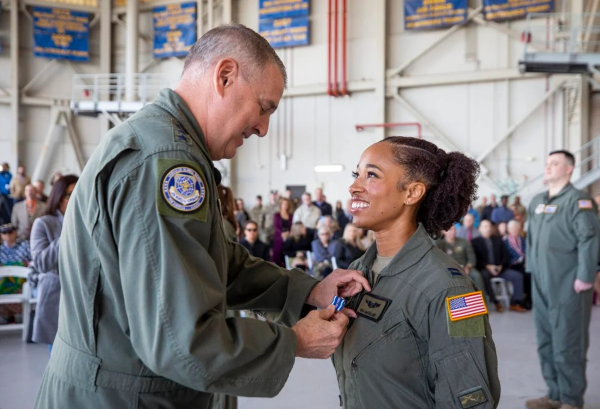
2017 USAFA graduate, Captain Rhea McFarland, is awarded the Air Force’s highest honor for acts of heroism or extraordinary achievement during aerial operations. During a ceremony on November 21, 2022 the C-17 pilot became the first African American woman to earn the distinction. (U.S. Air Force photo by Henry Taylor)
The bottom left quadrant is the tactical level. The Air Force should expect members to build upon temperance and integrity and add humility, accountability, and courage at the tactical level.[14] The person is learning the job fundamentals and expectations. These are the same traits Colin Powell displayed in the early stages of his career when he earned a promotion at the bottling factory for mopping well by doing the right thing at the right time. Later, he demonstrated accountability and courage by telling his supervisor he had lost his firearm. Upon attaining and demonstrating all the virtues above, the operational leadership level is the next benchmark.
At the operational level (bottom right quadrant), the person has been found competent, and the organization can generally rely on the individual’s virtue-based decision-making. The Air Force can assume the individual has fully embraced the core values.[15] At the operational leadership level, the airmen must build upon the previous virtues and develop wisdom, humanity, and judgment.[16] Colin Powell demonstrated these virtues when he pulled his commander from a helicopter crash without regard for his own life and well-being. If the candidate demonstrates the appropriate competence and virtues, the organization can promote them to the strategic level.
At the strategic or highest level of their career (top right quadrant), the individual is immersed in the organization’s values and illustrates a high level of character and virtue-based decision-making. They are fully committed to the organization, and the organization begins to take the individual’s high level of competence as a standard.[17] The Air Force should expect these individuals to exhibit humility and all virtues from the pre-affiliation, tactical, and operational levels, as Colin Powell molded all of the virtues one would expect during his time as the Secretary of State. Namely, he showed humility upon exiting the Bush administration when he discussed his disappointment with his performance. This model is described in terms of a continuum because, at any point, the person can become incompetent in performing their duties or illustrate poor character.
Conclusion

MSgt Theodore Dinwiddie, director, Enlisted Test Course, coaches Airmen during a test event utilizing sUAS systems at Edwards Air Force Base, CA. The USAF Test Pilot School’s revamped Enlisted Test Course aims to accelerate the development and deployment of cutting-edge aerospace technology, while reinforcing critical thinking in the field. (U.S. Air Force photo by Lindsey Iniguez)
Character and competence are aspects of leadership that scholars and leaders continue to discuss and debate. Aristotle, Peterson and Seligman, Crossan et al., and others discussed the importance of character. The study of Colin Powell’s life and interviews reached the same conclusion as Peterson and Seligman, who studied world religions and people groups and discovered six virtues of character. In addition, Crossan et al. built upon Peterson and Seligman’s discovery and added five virtues of character. These virtues reveal highly desired attitudes and habits of mind that leaders should possess.
The Competence Character Continuum stems from the entanglement of competence and character. By setting character goals for each leadership level, the Competence Character Continuum is a potentially valuable tool for the Air Force to evaluate candidates’ readiness and eligibility for promotion. Temperance, courage, humility, accountability, wisdom, judgment, humanity, integrity, authenticity, and self-examination are critical to success as leaders and traversing the Competence Character Continuum. The continuum is a potential tool for the Air Force to track an Airman’s performance and development in terms of both competence and character, and its use increases the likelihood of selecting suitable candidates to lead the force into the future.
The views expressed in this article are those of the author and do not necessarily reflect the official policy or position of the Air Force, the Department of Defense, or the US Government.
About the Author
Lt Col Michael A. Bradford is a USAF Missileer. After graduating from the University of Oklahoma’s Reserve Officer Training Corps program in 2008, he served in a variety of assignments, including 341st Missile Wing Emergency War Order Instructor, 576th Test Operations Squadron Assistant Director of Operations and Officer Training School 217th Training Squadron Director of Operations. He is a Master Instructor who has educated Airmen in operation, accession, and professional military education programs. He served on the 9th Air Expeditionary Task Force – Afghanistan Staff as the Deputy A3 and supported Operations in United States Central Command (CENTCOM) as the Rotations Branch Chief. He holds degrees in political science and military operational art and science. After graduation from the School of Advanced Air and Space Studies, he is currently assigned to CENTCOM J5 MacDill AFB, as a Strategic Theater War Planner.
Works Cited
[1] Aristotle and Roger Crisp, Nicomachean Ethics (Cambridge, U.K.: Cambridge University Press, 2000), 23.
[2] Richard E. Boyatzis, The Competent Manager: A Model for Effective Performance (New York: Wiley, 1982), 12.
[3] Jan Wiener, “Evaluating Progress in Training: Character or Competence?,” Journal of Analytical Psychology 52, no. 2 (2007): 178.
[4] Frederick Winslow Taylor, The Principles of Scientific Management (New York: W. W. Norton & Company, Inc, 1911).
[5] Mark A. Welsh III, Air Force Instruction 1-2 (Washington, D.C: SAF/IG, 2014), 3, https://www.af.mil/Portals/1/documents/csaf/afi1_2.pdf.
[6] CSAF: It’s Not About the Metal (Maxwell Air Force Base, 2024), https://www.airuniversity.af.edu/News/Display/Article/3772127/csaf-its-not-about-the-metal/.
[7] Christopher Peterson and Martin E. P. Seligman, Character Strengths and Virtues: A Handbook and Classification (Washington, DC : New York: American Psychological Association ; Oxford University Press, 2004)., 51.
[8] Monzani, Seijts, and Crossan, “Character Matters: The Network Structure of Leader Character and Its Relation to Follower Positive Outcomes. PLoS ONE 16(9): E0255940.,” 3.
[9] Sturm, Vera, and Crossan, “The Entanglement of Leader Character and Leader Competence and Its Impact on Performance.”
[10] John Eastin Van Maanen and Edgar Henry Schein, “Toward a Theory of Organizational Socialization,” Massachusetts Institute of Technology, 1977, 22, https://dspace.mit.edu/bitstream/handle/1721.1/1934/?sequence=1.
[11] Van Maanen and Schein, 24.
[12] Air Force Instruction 1-1 (United States Air Force, 2023), 5, https://static.e-publishing.af.mil/production/1/af_cc/publication/afi1-1/afi1-1.pdf.
[13] Christopher Peterson and Martin E. P. Seligman define integrity as a willingness to say what is true, not trying to present oneself as something they are not (authenticity) and being sincere. Character Strengths and Virtues: A Handbook and Classification (Washington, DC : New York: American Psychological Association ; Oxford University Press, 2004) Mary Crossan et al. mentioned that a person of integrity’s peers and leadership view their actions as aligned with their professed values and beliefs. They further describe a person of integrity as one who maintains a high moral standard for themselves and does not bend in the face of difficult circumstances. “Developing Leadership Character in Business Programs,” Academy of Management Learning & Education 12, no. 2 (2013): 285–305.
[14] Mary M. Crossan et al. defines humility as sincere appreciation and love for others. Along with their love for others, they sympathize with others’ morals, emotions, and values. They define accountability as taking responsibility for their actions, dependability, and ownership of complex issues” 1004. “Toward a Framework of Leader Character in Organizations,” Journal of Management Studies (John Wiley & Sons, Inc.) 54, no. 7 (November 2017): 1000. Peterson and Seligman define courage as any act or consistent pattern of life that requires a person to sacrifice comfort and maintain integrity, Character Strengths and Virtues, 36.
[15] Gardner et al., “Not Just for Newcomers.”
[16]Peterson and Seligman define wisdom as knowledge gained through struggle presented in a noble fashion that everyone appreciates, Character Strengths and Virtues, 39. They define humanity as the interpersonal ability to give more than is reasonably required, forgive when one could punish, and show kindness when recompense is impossible. Character Strengths and Virtues, 37. Monzani, Seijts, and Crossan define judgment as the ability to make analytical decisions quickly with little information in challenging circumstances, “Character Matters: The Network Structure of Leader Character and Its Relation to Follower Positive Outcomes. PLoS ONE 16(9): E0255940.,” 3.
[17] Robert M. Marsh and Hiroshi Mannari, “Organizational Commitment and Turnover: A Prediction Study,” Administrative Science Quarterly 22, no. 1 (March 1977): 57, https://doi.org/10.2307/2391746.